The Knot Garden and Its Patterned Past
Knot garden design turns clipped lines into a readable woven pattern. Learn its defining features and how to adapt the idea to a northern garden.
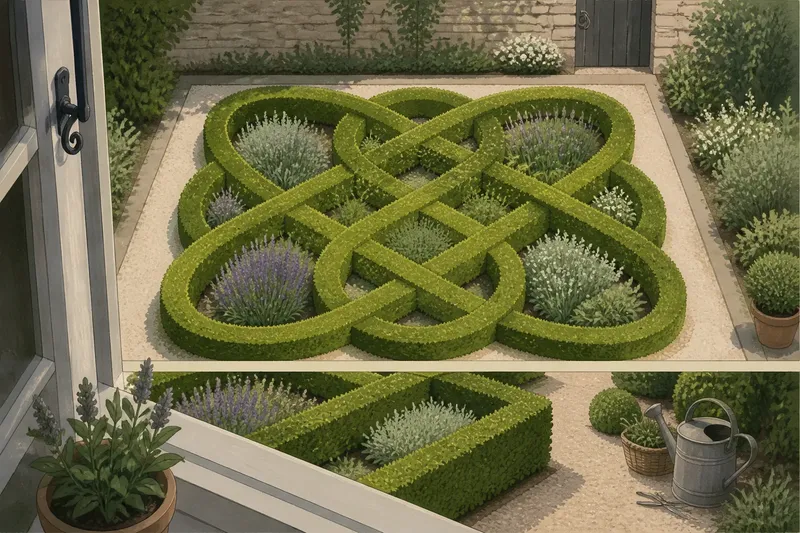
From an upstairs window, a clipped hedge can look like a drawing laid over the soil. Knot garden design depends on that view: bands seem to pass over and under one another, while planted spaces fill the openings. The pattern is easier to understand than its full history, so it is best to separate the recognizable form from claims about when or where it began.
Knot garden design
A knot garden is defined by interlacing lines. The bands form loops and crossings that suggest a woven cord. From the ground, you see the edges in sequence; from a window or terrace, the whole motif becomes legible.
The pattern, rather than a particular plant, gives the garden its identity. Low clipped hedges often outline the lines, while herbs, flowers, foliage, gravel, or bare soil may fill the compartments. If the lines merely divide rectangular beds, the result may be formal, but the knot effect is missing.
The exact historical development of knot gardens varies across accounts and places. Without reliable dates and sources, it is more accurate to describe the established visual form than to assign it a single origin or claim a precise route into northern gardens. The interlacing motif belongs to a broader decorative vocabulary of braided and woven ornament; that resemblance explains the name without settling a chronology.
Edges and interiors
Clipped evergreen boundaries help the pattern remain visible when seasonal flowers fade. Box is a familiar choice because its small leaves can make a dense edge, but it is not required. Other compact plants may suit a site better, depending on light, soil, exposure, and the gardener’s willingness to trim.
The interior planting should make the outline easy to follow. Herbs can bring scent and culinary use; low flowers and foliage can add contrast. If the interior looks too much like the edging, crossings blur. If every compartment competes for attention, the pattern can be difficult to read for a different reason.
For a plant choice, check the plant’s label for mature form and site preferences, then compare those needs with the bed’s conditions. There is no product manual involved. If the plant needs a shape or level of care the site cannot support, choose a more suitable edging rather than expecting the pattern to solve the mismatch.
Reading the pattern
A knot garden is often part of a larger formal arrangement, with paths, walls, or other beds framing it. A raised terrace or upper window may show the complete design. At ground level, a path lets visitors inspect the clipped edges and planted compartments. The garden therefore offers two views: an overall ornament and a walk through its parts.
The term is sometimes used loosely for any compact formal bed with clipped lines. The useful distinction is the crossing: a knot pattern should let the eye trace bands that appear to weave over and under one another. A parterre is a broader kind of formal garden arrangement and may use compartments or scrolls without that interlacing.
More turns do not necessarily make a stronger design. Each junction needs to remain clear and accessible for trimming. In a northern garden, damp conditions and vigorous growth can soften edges, so a restrained pattern may be easier to keep legible.
Planning a knot garden
Start with a drawing, not a list of plants. Mark the outer boundary, trace each band continuously, and view the plan from the place where it will most often be seen. Then decide what will form the edges and what will fill the enclosed spaces.
Say you have a small square beside a back door, a view from an upstairs window, and a preference for herbs. You sketch two broad bands that cross and return, then leave open compartments for low-growing herbs. From the window, the crossing reads as a woven route; from the path, the compartments remain easy to distinguish. If the pencil lines merge at a junction, remove a turn or widen the gap before choosing plants.
- Check whether the full design is visible from a window, terrace, or path; if no useful view exists, simplify the motif or place the pattern where it can be seen.
- Check whether each band can be traced continuously through every crossing; if a route disappears, redraw the junction or remove that crossing.
- Check whether the edging plant suits the bed’s light, soil, and exposure; if its needs do not match the site, select another compact plant or use a nonliving edge.
- Check whether the interior material contrasts with the edging; if the boundary disappears, change the interior planting or choose a clearer edge.
- Check whether you can reach every hedge and compartment for trimming and weeding; if access is awkward, widen the working spaces or reduce the number of compartments.
- Check whether the design still reads when flowers are absent; if it does not, rely more on persistent edging and less on seasonal color to define the crossings.
Common knot garden questions?
Does a knot garden need box?
No. Box is a traditional-looking edging choice, not a requirement. Select a compact plant that suits the site and the amount of clipping you are prepared to do.
Can a knot garden work without a raised view?
Yes, but the complete woven effect may be harder to see from ground level. Keep the pattern compact and give visitors a path or clear standing place from which they can follow the crossings.
How is a knot garden different from a parterre?
A knot garden is identified by interlacing bands that suggest weaving. A parterre is a broader formal arrangement and can include patterned beds without crossings.
Effort and upkeep
A precise pattern needs access for clipping and weeding. Narrow compartments can be awkward to reach, especially when there is no firm place to stand. Leave room to work along the edges, or reduce the pattern until its maintenance fits the available space.
Not worth the effort: copying a complicated historic motif line for line when the site offers no clear view and no practical access for trimming. A simplified interlace keeps the defining idea without turning every visit with shears into a negotiation.
Knot garden design is most useful as a way to organize a view, not as a demand to recreate a particular historical plan. Keep the crossings unmistakable, choose an edging suited to the site, and allow access to maintain it. Those decisions let the woven pattern remain readable from the window and underfoot.