Why Repeated Shapes Give a Border Its Rhythm
Repeated plant shapes give a border rhythm without making it uniform. Learn how to place, space, and vary familiar forms for a connected planting.

You can spot the gap before you reach the border: a tall iris stands alone, then the eye jumps across a stretch of unrelated foliage to a clump of geranium. Repeated plant shapes give a border rhythm by making those separate patches answer one another. The aim is not to match every plant, but to give the eye a few familiar forms to follow.
Choose a visual vocabulary
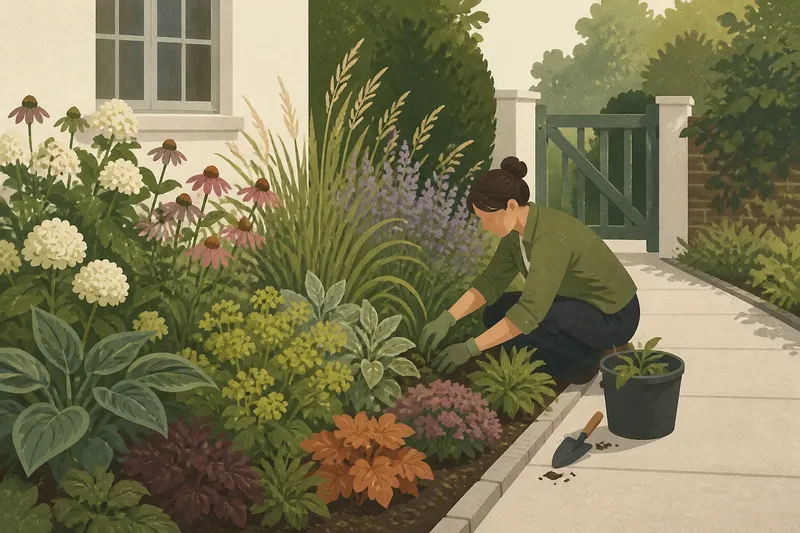
Think in shapes before you think in a long shopping list. A border might use upright spires, rounded mounds, and fine-textured grasses as its main forms. Each shape has a different job: spires mark a vertical beat, mounds provide rests, and grasses soften the spaces between them.
These are visual categories, not strict botanical ones. A salvia spike and a foxglove tower both read as vertical accents, though their flowers and foliage differ. Likewise, a low catmint clump and a compact hardy geranium can share a rounded outline without being interchangeable in every garden condition.
Keep the vocabulary small enough to recognize at a glance. If every plant contributes a new silhouette, the border may look busy even when its colors are restrained. Repeating a few forms creates continuity; differences in leaf shape, flower, and timing keep that continuity from becoming a row of copies.
Place the repeated forms
Repetition works best as a loose sequence. A familiar mound can appear near the front, return farther along, then appear once more near a bend. The eye notices the recurrence, while the changing neighbors make each appearance feel situated rather than stamped out.
Try a staggered arrangement instead of setting matching plants at equal intervals. A group of three rounded plants might be offset, with one slightly forward and two behind. A similar group farther along can be smaller or partly screened by a taller plant. The shared outline carries the rhythm; the altered arrangement supplies variation.
Use repeated forms to link parts of a border that already have different conditions. One end may receive more sun, while a nearby wall creates a sheltered pocket. A recurring upright accent can connect these areas visually, but choose a plant suited to each position rather than forcing one species into both. The form can repeat even when the plant does not.
Say you have a narrow border beside a fence, with a sunny end and a cooler section near a gate. You could repeat the upright shape of salvia in the sunny stretch and use a shade-tolerant plant with a similarly vertical outline near the gate. The expected visual result is a sequence of upward accents, while each plant remains matched to its own spot.
Leave room for shape
Spacing determines whether a repeated form remains legible. If mature clumps press together, their outlines merge into one continuous mass. If they sit too far apart, each can look like an isolated specimen rather than part of a pattern. Set plants by their expected mature spread and the width of the gap you want to preserve, using the plant label or supplier’s guidance as a starting point.
Then read the border from its usual viewing point. A narrow bed viewed from a path may need a clearer sequence than a deep border seen from a lawn, where plants can overlap in layers. In a deep bed, place recurring shapes at different depths so that the repeated form appears again through the planting rather than forming a straight line.
Leave some open ground between young plants if their mature foliage is meant to meet later. That space is not a flaw to fill with every spare plant. It gives the shapes room to emerge, and it lets you see whether the sequence is working before the border reaches its full size.
Vary the repetitions
Repetition does not require identical plants. Keep one feature steady and vary another. You might repeat a mound shape while changing flower color, or repeat a fine, arching texture through grasses of different heights. The steady feature is what the eye recognizes; the variation keeps the border from feeling mechanical.
Variation can also come from placement. A repeated plant may sit in a small group in one section and appear singly in another. The group reads as a stronger beat, while the lone plant can act as an echo. Avoid making every recurrence equally prominent, or the whole border competes with itself for attention.
Seasonal changes add another layer. A plant whose foliage holds a rounded shape after flowering can carry the pattern beyond its bloom period. Elsewhere, a vertical plant may provide its main outline while flowering, then become less noticeable. Use more than one plant to carry a shape through the season if the border needs a steadier visual thread.
Read the border from afar
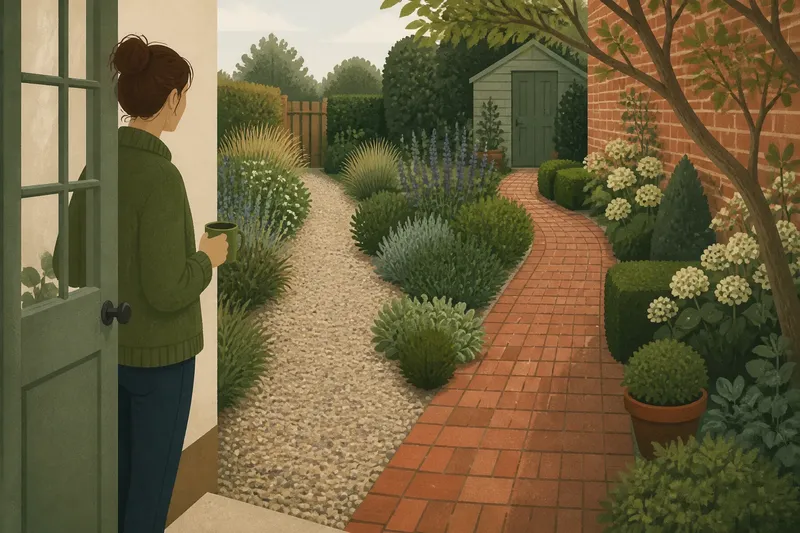
Repeated shapes can be hard to judge while standing among them. Walk back to the path, doorway, or window from which you usually see the planting. Look for a sequence: does the same kind of form return, and are there enough differences between repetitions to prevent a rigid row?
A quick sketch can help. Draw only broad blocks for mounds, vertical marks for spires, and loose lines for fine-textured plants. Leave flower colors out at first. If the shape pattern is confusing in a simple sketch, more color is unlikely to clarify it.
As plants grow, edit with restraint. A misplaced clump may be moved while it is young, but not every uneven interval needs correction. Natural variation in height and width is part of what makes a planted border feel composed rather than laid out with a ruler.
Questions about plant shapes?
How many shapes should a border repeat?
There is no fixed number, but a small set is easier to recognize than a separate silhouette for every plant. Start with a few forms that suit the site, then add another only if the border needs a different visual role.
Can different plants share one shape?
Yes. Plants with similar outlines can create a visual link even when their flowers, foliage, or growing conditions differ. Treat the shared form as a design choice, not a reason to ignore what each plant needs.
Should repeated plants be evenly spaced?
Usually not. Uneven spacing and staggered placement make the repeated shape feel woven into the border, while equal intervals can suggest a formal row. Use spacing that suits mature spread and the way the bed is viewed.
What is not worth repeating?
Not every small leaf or flower needs a planned echo. Repeating too many details can make the planting fussy, and moving established plants merely to perfect an interval is often more effort than the effect deserves.
A useful closing edit
When the border feels disconnected, identify the shape that appears least often and ask whether it should return somewhere nearby. Add a repetition only if it connects two parts of the planting or clarifies the view from a regular vantage point. Repeated plant shapes give a border rhythm through recognition, not duplication; one well-placed echo can do more than a row of matching plants.